
With 72% of manufacturers worldwide now prioritizing sustainable materials, selecting the right biopolymer. To ensure your products are high quality, you need to find a way to meet customer specifications and ESG goals.
These natural polymers are transforming entire industries, from pharmaceuticals and medical devices to agriculture, water treatment, cosmetics, and food packaging.
One of the most interesting emerging biopolymers is the marine-derived chitosan, which is fast becoming popular on a global scale for its unique adaptability and high added value performance.
But just how does chitosan stack up against other well-established natural biopolymers like cellulose, gelatin, or alginate?
By partnering with the right chitosan manufacturer, Fresh On Time Seafood that is fluent both in material science and industry-specific requirements, the amazing capacity of chitosan can be fully unleashed.
Whatever type of product developer you are – from food and drink developers looking for bioactive compounds, sustainability officers in search of circular raw materials, to procurement managers responding both to regulatory change and consumer demand for greener inputs – this guide has you covered.
Fresh On Time Seafood, established by Bintarna Tardy in 2004, is a trusted global manufacturer and supplier of premium seafood and chitosan products made from crab shells.
Our sustainable and innovative approach serves a wide range of industries, including food, healthcare, cosmetics, agriculture, and water treatment. We are committed to delivering consistent quality, exceptional service, and reliable solutions to clients worldwide.
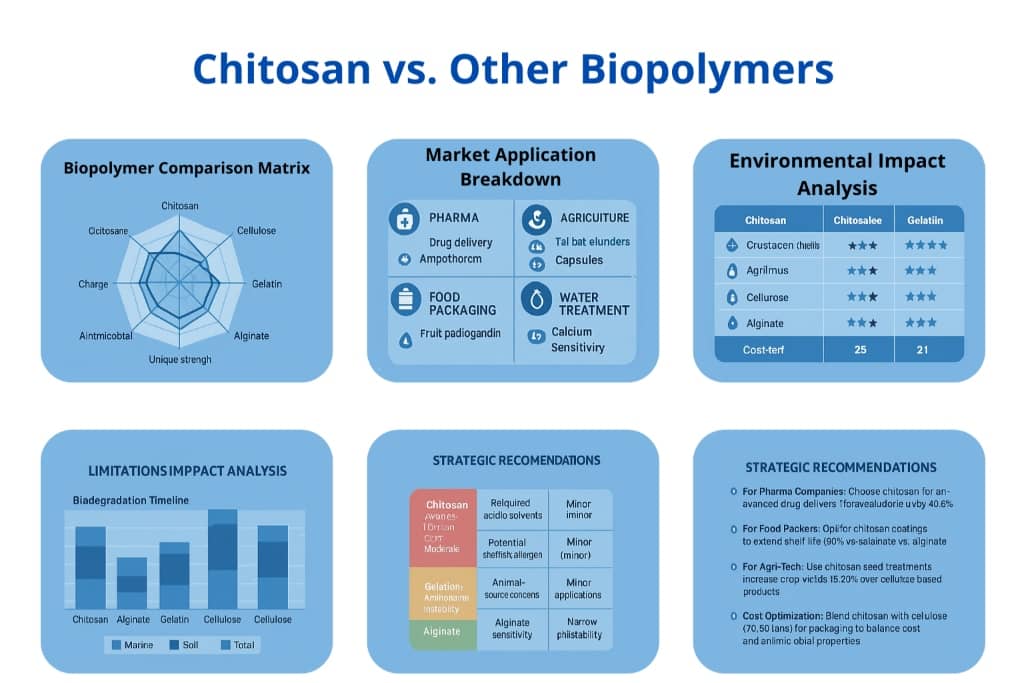
Chitosan vs Cellulose vs Gelatin vs Alginate Key Differences
It is important to understand that each of these biopolymers is unique before making application comparisons.
Chitosan
It is a linear polysaccharide consisting of glucosamine and N-acetyl glucosamine subunits, and chitosan is derived from chitin, which, in turn, is often found in the shells of crustaceans (e.g., crab, shrimp, etc.).
Chitin is deacetylated, or changed into chitosan, by this process, which imparts chitosan with unique biological and chemical attributes.
Structure: Cationic polymer (positively charged)
Carbon Source: Shrimp/crab shells (crustacean waste)
Key Features: Antimicrobial, mucoadhesive, biodegradable, and biocompatible.
What is the best source of chitosan?
The most common and effective source of chitosan is shrimp shells, which are widely available as a byproduct of seafood processing. Other sources include crab shells and the exoskeletons of insects like beetles. Among these, shrimp shells are typically preferred for industrial production due to their abundance and high chitin content.
A qualified chitosan producer will use high-quality crustacean shells, and will have standardized methods to ensure consistent properties of the material.
Cellulose
Cellulose, a versatile cellulose, the most abundant biopolymer on earth, comes from plant cell walls. It’s a neutral, water-insoluble polymer that’s usually chemically modified in order to be used as a food additive.
Structure: Neutral polysaccharide containing glucose residues
Source: Wood (cotton, agro- industrial)
Key Attributes: Good mechanical strength, can be used to produce films, non-toxic, biodegradable
Gelatin
Gelatin A proteinaceous biopolymer resulting from the hydrolysis of collagen, gelatin is an inexpensive and widely used compound in the food, pharma, and cosmetic fields.
Structure: Proteins (chains of amino acids)
Source: Animal bones, hides & connective tissues
Key Features: Thermo-reversible gelation, film forming, digestible, biodegradable
Alginate
The polysaccharide alginate is derived from brown seaweed. It gelatinizes in the presence of calcium ions and is widely used in biomedical and food applications.
Structure: Mannuronic and guluronic acid – an anionic polymer
Source: Brown impression (Laminaria, Macrocystis)
Properties: Gelling agent, biocompatible/bio-degradable, non-toxic
Biodegradability and Environmental Concerns
Chitosan
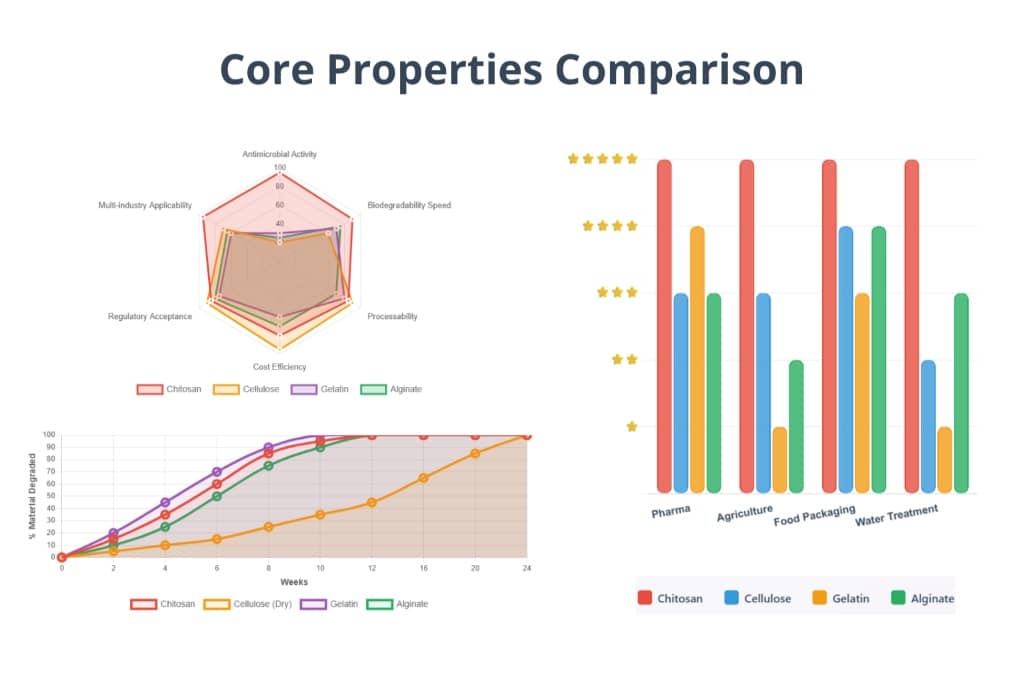
Chitosan is biodegradable within a short period of time in both soil and water. It decomposes into nitrogen-rich compounds harmlessly consumed by marine life.
Its ability to biodegrade in a range of conditions from aquatic systems is high. Also, it is compostable and causes little ecological danger.
When considering environmental impact, having a responsible chitosan supplier will pursue maximizing the degradability goodness as it is the case of biodegradation.
Although not the topic, producing in a way that reduces manufacturing energy intensity is a necessity, especially when looking for carbon footprint reduction of the manufacturing process.
Cellulose
Cellulose, although it is itself biodegradable, decays slowly if it is not moist. It’s compostable and recyclable and can be mixed with synthetic plastics to make it stronger, longer-lasting, and more functional.
This factor may sometimes influence its biodegradability in general. However, cellulose is typically safe for composting and recycling.
Gelatin
Other enzymes and microorganisms also easily destroy gelatin, which does not keep well. It decomposes rapidly and is safe for landfill use. Just like other biopolymers, it is compostable and has little environmental impact.
Alginate
It’s an all-natural product and breaks down in wet conditions, so you never have to worry about degrading in your aquatic ecosystem. It is nontoxic to marine organisms, and similarly as other biopolymers, is biodegradable, rendering it as sustainable material for diverse uses.
Solubility and Processability
The solubility is one of the key factors that influences the applicability of a polymer in various industries. Here’s what each biopolymer does:
- Chitosan: Solubility results in mild ACIDIC (acetic acid) clear, flexible solutions (films, gels, coatings).
- Cellulose: water-insoluble; chemically derivatized (e.g., CMC, HPMC) in order to form.
- Gelatin: Soluble in warm water, forms a gel on cooling - thermal reversible.
- Alginate: Soluble in cold water and gels with calcium salts, and there is no rework.
This unique quality makes chitosan a perfect material that provides a compromise, readily dissolves in mild conditions and is able to be easily transformed into different shapes. It not only doesn’t need much in the way of cooking chemicals, as with cellulose.
Chitosan vs Rivals: The Showdown Of Biopolymers
Pharmaceutical & Biomedical
Chitosan: Controlled drug release, wound closure, tissue regeneration, surgical stitches.
Cellulose: Tablet binders, capsules (HPMC).
Gelatin: Capsule casing, wound dressing.
Alginate: In wound gels, drug encapsulation.
Moreover, chitosan is inherently mucoadhesive and bioactive, it is an attractive system for advanced drug delivery.
Is Chitosan Good for the Liver?
Yeah, chitosan might be good for your liver, particularly if you’re on a reduced calorie intake. Research has found that consuming 1.5 grams of chitosan daily for eight weeks can promote weight loss as well as decrease waist circumference, enhance liver function, and even ameliorate symptoms of non-alcoholic fatty liver disease (NAFLD). That said, you should always talk to your health care provider before trying any supplement.
To meet drug applications, it’s particularly important that a GMP-certified chitosan producer be selected to guarantee safety, efficacy, and GMP and regulatory compliance for worldwide markets.
“In pharmaceutical applications, chitosan’s mucoadhesive properties and biocompatibility make it superior to traditional polymers. Its ability to enhance drug bioavailability while being completely biodegradable represents a significant advancement in drug delivery systems.” – Dr. Sarah Kim, Source: WHOI
Agriculture
Chitosan: Biopesticide, seed coating, and plant immune enhancer.
Cellulose: Mulch Film, Slow-Release Fertilizer Base.
Gelatin: Gelatin is supposed to be an organic fertilizer(less common).
Alginate: A slanted, water Retaining-Agglomerated sauced your plant with water.
Chitosan prepares plants for battle naturally and promotes good soil health of the microorganisms.
Food Packaging & Preservation
Chitosan: Coating, antimicrobial film, shelf life extension.
Cellulose Bioplastic composites, paper films.
Gelatin: Food films, capsules, emulsifiers.
Alginates: Thickeners in foods, coatings on fruits and vegetables.
Antimicrobial Chitosan Food safety and food preservation are the main applications for chitosan
.
Water Treatment
Chitosan: Flocculation, heavy metal adsorption, and dye removal.
Cellulose: Membranes (Derivatives).
Gelatin: Limited use.
Alginate: Heavy metal removal (lab scale).
Let’s face it, what removes the bad stuff from water? Its power to naturally flocculate puts it in the running for industrial wastewater treatment, putting the others in the category of catching up, at best in niche labs or small, experimental production.
Cost and Availability
Chitosan: Mid-range cost. Although it costs a little more than cellulose, it can pay for itself in function.
Cellulose: Very cheap because of its availability; commonly employed in mass production.
Gelatin: Fairer-priced but subject to swings in raw material markets.
Alginate: Mid to high; subject to seaweed crops.
It’s like the difference between instant noodles and a real meal, cellulose is cheaper, but chitosan will get the job done without you feeling hungry for performance.
In addition, taking into account performance per unit weight, chitosan is both cost-effective and more sustainable than petroleum-based antiscale materials over medical, environmental, and agricultural applications.
Limitations to Consider
Although chitosan has accomplished a great deal, discerning its limitations allows its application to be optimized.
Chitosan: Insoluble in water of pH 7 or more in the absence of acid. Shellfish-derived may also pose allergen concerns (albeit greatly reduced in processing).
Cellulose: Needs derivatization; no moisture barrier.
Gelatin: Thermal Unstable; animal based (religion/ethic reasons).
Alginate: Alginate is unstable in high-calcium conditions and is more limited in the control of pH.
5 Benefits of Switching to Chitosan for Global Brands
Chitosan is not simply a specialty material, it is a vehicle for innovation for virtually any business that is looking for sustainable, high- quality performance.
Let’s be real, if chitosan were a person at a biotech convention, it’s the one everyone’s sub-plotting to poach. What is the specialty of chitosan over other biopolymers?
Multitalented: Its dual performance as a film former, binder, stabilizer, and encapsulation agent is truly priceless, particularly in pharmaceuticals, agriculture, foodtech & water treatment. It’s one material with so many uses.
It’s the Swiss Army knife of natural polymers, minus the sharp edges. Why bother with three ingredients when you could use one chitosan?
Natural antimicrobial action: Organic thyme’s antimicrobial action has the potential to diminish the need for synthetics preservatives, antibiotics, and fungicides, contributing to cleaner labels and organic-certified products.
Tunable properties: The viscosity, solubility and molecular weight of chitosan can be tailored by manufacturers, who can do so depending on the degree of deacetylation, the process can be precisely controlled thus tailored formulations across markets are possible.
Eco-Chemistry: Chitosan is naturally non-toxic, biodegradable, and ocean-safe, and highly in line with global ESG and green innovation directives.
It’s like your apology letter from nature for plastics, except this one actually works. If you are creating a greener brand, this will be your secret sauce.
Global Compliance Trust: CFR 21 compliant (FDA) ,EU, AP (for food contact, pharmaceutical, cosmetic, and organic agriculture) approved.
Fresh On Time Seafood is The Best Chitosan Manufacturer Why?
At Fresh On Time Seafood, we don’t just supply chitosan– we co-create with you to achieve solutions designed to help you to reach your product innovation objectives. Our advantages are as follows:
Pharmaceutical-Grade Quality
We provide pharmaceutical-grade chitosan with quality– controlled deacetylation ratios (DDA) and molecular weight, which is essential for reliable absorption and bioactivity.
Formulations for Specific Industry Sectors
We custom engineer particle size, solubility and performance from agriculture-grade liquids to medical-grade powders that satisfy your specific application.
Precision isn’t an add-on, it’s our baseline. Whether you’re going to be using it to coat seeds or to develop a delivery system for drugs, we have the right grade for you.
Regulatory Compliance
Our products comply with the USP, EP, and JP pharmacopeias as well as organic standards such as USDA Organic or EU 2018/848.
Supply Chain Reliability
AMATA’s purchasing is made sustainable by long-term relationships with our suppliers and by our expertise in raw material processing, which means that even in times of raw material price volatility, we can provide a reliable supply.
Technical Support & R&D Cooperation
We can help with custom trials, regulatory documentation, and pilot- scale batches, working alongside your team from concept through commercial.
Sustainability at Core
We upcycle crustacean byproducts to make valuable chitosan, thus fostering a circular economy and decreasing the seafood industry’s waste. We turn yesterday’s shrimp shells into tomorrow’s clean tech. Not a bad form of sustainable innovation, that.
Let’s Build Better, Together
On the cutting edge of innovation and sustainability, chitosan is a game-changer.
Because when you are creating the next wave of such things as pharmaceuticals, eco-friendly materials for use in agriculture, products with clean labels or advanced water treatment, this natural biopolymer provides not only functionality but a way forward.
It’s not only science, it’s smart business. Plus, it just so happens to be good for the planet.
At Fresh On Time, we view chitosan as anything but an ingredient. It’s an engine for more intelligent, more secure, and more sustainable products.
It’s the reason why the world’s top brands, scholars, and manufacturers in every field trust us and rely on us to help them turn that power into magnetic items, not only for our vast array of quality material options but for our relationship-first mentality.
So we are not just selling molecules. We’re powering the next generation of breakthroughs.
We don’t just provide chitosan. We believe in innovation, and we’ll lend you themes for sample-making, for your trial edition, for your early, stage promotion, and for test marketing, among others.
Get technical support, regulatory assistance, or the item you’re looking for, let’s co-create.
As if that isn’t enough, your mind- blowing thought for the day is a biodegradable material that improves the performance of your product without being difficult to dispose of in a circular economy. Oh, that’s chitosan, especially if you’re getting it responsibly sourced and processed.
Are You Ready to Begin With Confidence?
Let’s connect. We’ll guide you through how our pharmaceutical-, food-, or agriculture-grade chitosan can integrate into your current pipeline or inspire your next product innovation.
Call us today for custom samples, application-specific data sheets, and technical support.
Let’s build products that aren’t just high-performing, but future-proof, nature-friendly, and engineered to keep pace with sustainability-driven markets.
By selecting Fresh on Time Seafood, you’re not just choosing some biopolymer. You are designing for a better construction.
FAQ
Which biopolymer fits my industry needs: chitosan or other alternatives?
If you need a biopolymer that’s versatile, eco-friendly, and works well across many industries, chitosan is a great choice. It naturally fights bacteria, helps clean water, and works as a film or coating. You can also adjust it to fit products in pharma, farming, food, and more.
Is chitosan safe for use in food, pharmaceuticals, and cosmetics?
Yes. Chitosan is approved for use in food contact, cosmetics, organic farming, and pharmaceuticals by regulatory bodies in the U.S., EU, and Asia-Pacific. It’s non-toxic, biodegradable, and considered ocean-safe.
Why choose Fresh On Time Seafood as a chitosan manufacturer?
Fresh On Time Seafood offers pharmaceutical-grade chitosan with custom formulations, strong regulatory compliance, and sustainable sourcing. Their R&D support, technical consultation, and consistent quality make them a preferred partner for innovation across industries.
How does chitosan perform in water treatment applications?
Chitosan acts as a powerful natural flocculant, capable of removing heavy metals, dyes, and suspended solids. Its superior binding ability makes it more effective than alginate or cellulose-based adsorbents, especially in industrial wastewater treatment.
Which chitosan source is best for pharmaceutical use: Shrimp or crab shells?
Shrimp shells are preferred for pharma-grade chitosan due to higher purity and consistent deacetylation (DDA >85%). Fresh On Time Seafood uses traceable shrimp shells tested for heavy metals and allergens.