
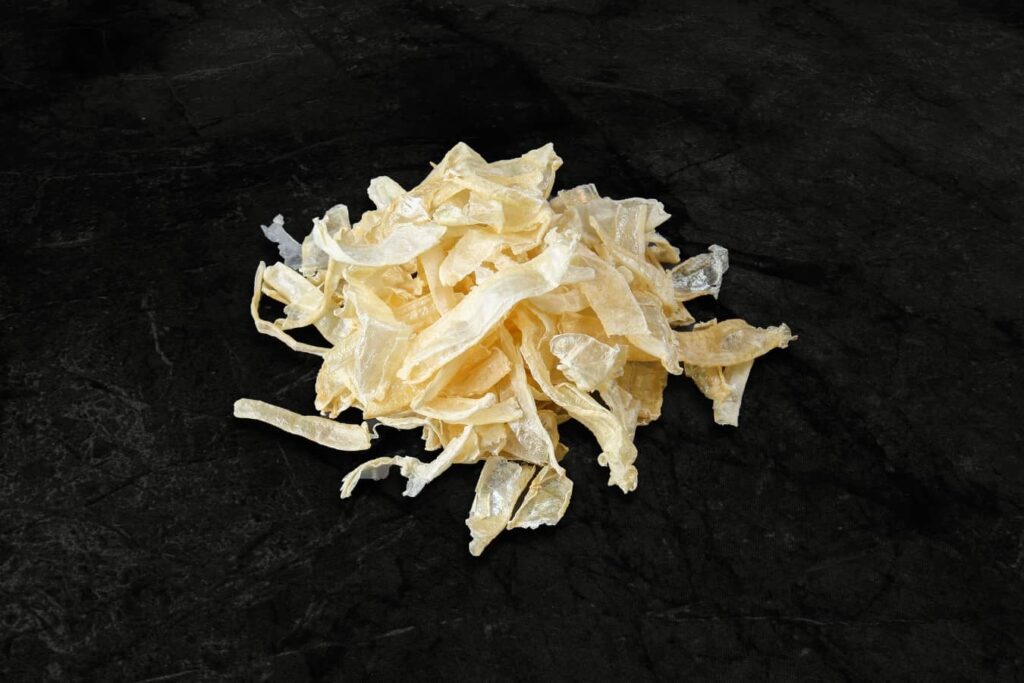
Chitin is the world’s second-largest biopolymer, being surpassed only by cellulose. This extraordinary biopolymer is the basis of the structure of countless organisms- crabs and lobsters have their shells made of it, insects have their exoskeletons made of it, and fungi also have cell walls of it.
Exploring the properties, discovery, and development of chitin to current uses helps one to appreciate why this ancient molecule has become one of the most exciting biomaterials of our days as a low-cost, green solution in the industry.
A naturally occurring polymer found in the shells of crustaceans, the wings of beetles, and the durable framework of mushrooms, chitin acts as nature’s own armor and scaffolding.
Few can resist its unique combination of strength, flexibility, and biodegradability, a trifecta that has captured the attention of scientists, engineers, and manufacturers across the globe.
From a waste product of the fishing industry to a fundamental resource for green technology, Chitin’s story is one of the most successful examples of how natural materials can be upgraded to industrial markets.
As demand for sustainable biomaterials continues to grow, a reliable chitosan manufacturer, Fresh on Time Seafood plays a crucial role in bridging the gap between marine waste and high-value industrial applications.
Today, companies worldwide are capitalizing on chitin’s remarkable potential, transforming what was once considered seafood waste into valuable industrial materials.
Founded by Bintarna Tardy in 2004, Fresh On Time Seafood is a respected international processor and supplier of quality seafood and chitosan products produced from crab shell.
Our sustainable and disruptive solution is applied across multiple industries, from food to healthcare, cosmetics, agriculture, and water treatment. We are dedicated to providing quality, value, and reliability, and keeping the needs of our customers first.
The Discovery of Chitin: A Milestone in Science
Henri Braconnot and the Discovery of the First Lecithin
The tale of chitin began in 1811 when the Frenchman Henri Braconnot, a professor, made a discovery that rocked the world while he was studying tissue from one of his mushrooms.
While experimenting in his laboratory at the Nancy Pharmacy School, Braconnot observed a novel material left after fungus was treated with potassium hydroxide. This enigmatic substance bore characteristics that had never been observed in any other biological material.
The material was called “Fungin” because it was found in foods such as stem mushrooms and chaga, and was assumed to be found in these foods and not in animals. This name was short-lived, being replaced by the new name “Chitin”, introduced by Braconnot.
His careful report pictured a nitrogenous compound of extraordinary resistance to acids and bases as it became the precursor to the study of this unique polymer.
Chitin Was Named in Honor of Auguste Rene Hilaire Hyacinthe Odier
In 1823, French chemist Auguste Odier was the first to show that the same materials found in insect cuticles were found in the tobacco leaf.
Odier was said to have named it “chitin” from the Greek word for “tunic/outer covering,” and there could be no better description for the protective qualities of this biological substance.
These early findings were more than just scientific curiosities. They unlocked the know-how to nature’s method of building strong but lightweight materials from basic organic compounds.
The findings themselves would one day change the world, but it would take 100 years for chitin to be given its full due.
What does chitin do to the human body?
Chitin isn’t digestible like typical nutrients, but it can still affect the body by interacting with enzymes and the immune system. Human enzymes like chitinases help break it down into smaller compounds. These compounds may support gut health and influence immune responses. Some studies also link chitin to prebiotic effects in the digestive tract.
From Seafood Waste to Wartime Wonder: Chitin’s First Industrial Uses
Early Industrial Applications
It had already been discovered that chitin had potential as an industrial material in the early 20th century, but attempts to use it had been hampered by processing issues.
Massive amounts of chitinous waste were generated by seafood-processing factories, but the retrieval of pure chitin was a formidable task, requiring cumbersome chemical treatment and apparatus.
Water Treatment and Textiles
The early industry development centered around chitin derivatives, particularly chitosan, which has improved solubility and processability properties.
Chitosan also displayed its effectiveness in water treatment for removing additives and clarification for binding with negatively charged particles.
The textile industry quickly found use of chitosan fiber for antimicrobial purposes, including medical textiles and protective clothing. Production costs were high, however, and thus use remained limited at first.
Agricultural Use and Wartime Origins
World War II sparked international interest in chitin research because countries were looking for substitutes for other materials. The Japanese helped pave the way, developing more efficient ways to extract chitin from crab shells, cutting costs and increasing productivity.
Following the war, chitin first obtained interest in agriculture.
- Its biodegradability and soil- enriching properties have paved the way for chitin- derived fertilizers and soil amendments.
- These early products showed value, such as enhanced plant growth and disease resistance; however, commercialization was restricted as processing was experienced as costly.
Chitosan: The Revolution and Weight Loss
What Is Chitosan?
The invention of chitosan, the deacetylated counterpart of chitin- turned the tide in favor of commercially feasible material based on chitin.
In contrast to the native chitin, the chitosan is more soluble in a weak acid medium, and this led to a large number of applications that were impossible under natural conditions.
Production Process
Chitosan is prepared from chitin by subjecting the polymer to treatment with strong alkaline solutions at high temperature conditions so that the acetyl groups are removed from the polymer backbone.
The deacetylation process typically requires careful control of temperature and alkaline concentration to achieve the desired degree of modification while preserving the polymer’s beneficial properties.
This chemical modification changes chitin to a positively charged polymer, showing much improved reactivity and processability; hence the modified chitin is ideally suitable for many industrial as well as biomedical applications.
Is chitin good or bad?
Chitin is generally considered good for health when consumed in moderate amounts. It acts like dietary fiber, supporting gut bacteria and improving digestion. Its slow breakdown helps it reach deeper into the colon, where it promotes healthy microbiota.
Main Food and Medicinal Functions
Applications in these early stages mainly consisted of the use of chitosan for water treatment and food processing, due to its natural antimicrobial and clarifying properties.
In the food sector, chitosan is employed as a natural preservative and film former, in particular in the coating of fruits and vegetables.
Medicine applications started in the seventies and eighties with chitosan- based wound dressings that are capable of accomplishing wound healing, protection against microorganisms, and biocompatibility.
Subsequent chemical modifications have permitted chitosan to be suitable for more advanced applications (i.e., drug delivery systems and tissue engineering scaffolds), making it a potential platform biomaterial for current biomedical applications.
Scaling Up Production: New Processing Technologies
Chemical Extraction Methods
The method of processing chitin has gone far past the crude methods used in the 20th century. In present- day chemical extraction methods, these have mostly been treated with acids, bases, and sequences thereof to remove proteins and minerals from raw materials.
Demineralization: The rest of the water is demineralized with hydrochloric acid to dissolve calcium carbonate and other inorganic material.
Deproteinization is then carried out with sodium hydroxide, removing all organic components and leaving behind pure chitin.
Biological and Enzymatic Solutions
Biologically based extraction methods are gaining popularity as a substitute for environmentally damaging techniques. The goal of these methods is to minimize wasted energy and promote sustainability.
- Enzymatic processes employ specific proteins to depolymerize non-chitin components while maintaining the polymer backbone.
- Fermentation processes are based on microorganisms digesting proteins and other organic substances, while the chitin formed is of high quality and the process turns out to be more environmentally friendly.
Advanced Purification & Particle Control
For pharmaceutical and food-grade applications, which have far more stringent requirements than the applications mentioned above, chitin must be highly purified:
Methods such as membrane filtration, chromatography, and other separation techniques help to remove any remaining impurities.
Availability of modern equipment also enables one to control the particle size accurately and thereby obtain chitin powders specifically designed for applications such as carriers of drug delivery systems and composites with high performance, in which uniform sizing is important for product functionality.
Chitin in the Modern Industry
Nowadays, chitinous materials occupy a variety of applications in different industrial fields, thanks to the versatility and special properties of this material.
Water treatment is one of the biggest commercial markets for chitin- based products, where chitosan flocculation is used for cleaning the water supply for municipalities and industries.
In agriculture, chitin has been used as a biostimulant and natural pesticide. When used on soil, chitin promotes the growth of beneficial microorganisms that help plants fend off diseases and take in nutrients. Other formulations incorporate chitin with other organic molecules to make full- spectrum soil health products.

Chitin and chitosan have been widely used in the cosmetics industry due to their moisturizing and film-forming characters. Skin conditioning benefits of these materials are featured in skin, hair, and color cosmetics products where enhanced texture is desired.
Textile uses are also advancing, in which modern chitosan fibers exhibit higher strength and better processing properties. Chitosan-containing antimicrobial fabrics are utilized in medical clothing, sportswear, and household textiles that require odor reduction.
The packaging industry is increasingly interested in chitin-based films and coatings as sustainable substitutes for synthetic polymedicators of proteins. Chitosan films also may be made to possess moisture and gas barrier properties, yet still are fully biodegradable.
New Developments, The Future of the Applications of Chitin
Nanotechnology and Intelligent Materials
New research is revealing chitin’s promise on the nanoscale, where it can be used for particles and fibers in electronics, sensors, and high-tech materials. These chitin- derived nanomaterials possess increased strength, surface area, and specific functionalities.
Besides, chitin-based smart material also has been prepared for sensors, actuators and responsive systems. Such material systems are capable of changing their properties according to environmental stimuli, offering the potential of adaptive, intelligent technologies.
3D printing and medicine Making medical devices
Its biodegradability, biocompatibly, and other inert properties, as well as 3D printability, make chitin a suitable material for 3D printing, such as for customized medical implants and biodegradable objects.
Thanks to the use of chitin-based filaments, manufacturers are able to produce complex, sustainable structures designed according to the medical or environmental requirements they address.
Energy Storage Applications
Scientists are also studying chitin and its potential in batteries and supercapacitors, specifically due to its being ion-conductive and having the ability to act as a supporting material for electrode materials.
These developments could pave the way for greener energy storage options in future generations of electronics and renewable energy systems.
Genetic Engineering and Bio-Manufacturing
Biotechnology is investigating genetically manipulated strains (GMOs) that could yield chitin with desired characteristics, suitable for considered industrial applications. This bio-manufacturing strategy has the potential to increase production efficiency, reduce cost, and produce tailor-made biopolymers for applications in medicine, materials science, and agriculture.
‘Chitin is one of the most abundant renewable biopolymers on earth that can be obtained as a cheap renewable biopolymer from marine sources. It is biocompatible, biodegradable and bio-absorbable, with antibacterial and wound-healing abilities and low immunogenicity.’ – Khoushab and Yamabhai (Source: PubMed Central)
Structure and Properties: The Miracle of Nature’s Engineering
Molecular Structure of Chitin
The chitin’s outstanding properties can be attributed to its complex molecular structure. Structurally, chitin is a linear polysaccharide of N-acetylglucosamine residues joined by β-1,4-linkages.
This construction results in long chains that can be organized into very regular crystalline structures, providing chitin with its extraordinary strength and stability.
Crystal Structures: Alpha, Beta, and Gamma
The polymer has three main crystalline forms: α-chitin, β-chitin, and γ-chitin.
Alpha-chitin, the most abundant type, has a number of anti-parallel chains tightly arranged that produce intermolecular hydrogen bonds between neighboring molecules. This structure is why crab shells and lobster skeletons can take heavy hits and still feel relatively light.
Fresh on Time Seafood, as a professional chitosan supplier, typically specifies which crystalline form their products contain, as this directly affects the material’s performance characteristics in end-use applications.
Beta-chitin, derived from squid pens and some marine species, has a parallel chain arrangement that provides more flexibility and ability to swell in water.
Gamma-chitin (the least natural) shares characteristics with both alpha and beta forms and is mainly encountered in a few fungi and yeasts.
Natural Architecture, New Alloy, New Design
What makes chitin especially interesting is that it can be organized to generate sophisticated hierarchical structures. In the exoskeletons of crustaceans, chitin fibers are arranged in layered structures, each layer being oriented at different angles with respect to ensure strength in various directions.
The architecture of this natural composite has driven newer engineering strategies for lightweight but strong advanced materials.
Fresh on Time Seafood, operating as both a chitosan manufacturer and a chitosan supplier, utilize advanced extraction techniques that preserve these natural structural characteristics, ensuring their products retain maximum functionality for demanding applications.
Molecular Weight Variability
Chitin has a broad spectrum of molecular weight, depending on the source and the extraction process, generally lying between 50,000 and several million daltons.
Chitins of higher molecular weights tend to have better mechanical properties, so the choice of source becomes critical for a particular application.
Conclusion: The Ongoing Evolution of Chitin
The evolution of chitin, from accidental discovery by Henri Braconnot in 1811 to a key component of modern advancement, is a testament to its legacy.
This very old biopolymer, evolved through hundreds of millions of years, will represent the core of solutions to many of the most urgent challenges of our time: from environmental degradation to the future of medicine.
The values that prospective industrial applications value are (i) strength, (ii) flexibility, (iii) biodegradability, and (iv) biocompatibility, the same values that chitin has in nature.
As chitin processing techniques mature and applications diversify, novel value chains and not just alternatives to man-made materials are being envisioned for chitin to address modern-day challenges in sustainability, healthcare, and industrial fabrication.
Understanding how chitin begins may just open your eyes to the way science and its passions and waste and its reprisals can play a role when breakthrough materials are at stake.
From the castoff shells of crabs to medical devices that form a covering around a beating heart, chitin demonstrates how natural resources can be coaxed and converted far beyond esthetic boundaries.
Beyond this, with humans under increasing environmental and economic pressure, the role of chitin in the future can only be expected to grow.
A renewable source (crustacean shells), environmentally compatible, with excellent properties, chitin might become the material for the next generation of sustainable technologies.
FAQ
What is chitin, and how did its discovery unfold throughout history?
Chitin is a natural biopolymer found in crab shells, insect exoskeletons, and fungi. Henri Braconnot first discovered it in 1811, and Auguste Odier later named it “chitin” from the Greek word for tunic. Over time, it evolved from a scientific curiosity into a valuable material for industry.
Who discovered chitin and when?
Henri Braconnot discovered chitin in 1811 while experimenting with mushrooms. He named it “fungin” before it was later renamed “chitin” by Auguste Odier.
What is the difference between chitin and chitosan?
Chitosan is a modified form of chitin created through a deacetylation process. Unlike chitin, chitosan is more soluble and easier to process for industrial applications.